
Don’t Bother Reviewing Pull Requests… Until the Build Passes
Don’t Bother Reviewing Pull Requests… Until the Build Passes
If your Bitbucket pull requests frequently fail an early CI build, adding reviewers before that build passes can waste reviewer time. Workzone Cloud can delay reviewer assignment until a successful build is detected, so reviewers are added—and receive the review request—only after the pull request has cleared that automated gate.
That does not mean every team should wait for every test in the pipeline before a human looks at the code. If CI takes a long time, or early architectural feedback is useful, automated checks and human review can run in parallel.
The practical rule is simpler:
Don’t spend scarce reviewer attention on code that is already known to be broken by a fast, objective check.
Key Takeaways
- Bitbucket already shows build status on pull requests and can use successful builds as merge checks.
- Workzone Cloud adds a different control: reviewers can be added only after a successful build is detected.
- This can reduce wasted review cycles when early CI failures are common and the preliminary build is reasonably fast.
- It is not always optimal to wait—long-running CI, exploratory reviews and architectural feedback may justify reviewing in parallel.
- A successful build is a readiness signal, not proof that the code is correct or ready to merge; human review and other merge conditions still matter.
The Problem: Reviewers Are Looking at Code That CI Already Knows Is Broken
Imagine a developer opens a pull request and five reviewers are immediately notified.
Two people start reading the change.
A few minutes later, the build fails because of a compile error, failing unit test or another basic automated check. The author fixes the issue and pushes another commit.
The reviewers have now spent time on a version of the change that is already obsolete.
That may not matter once. But on a busy team, repeating the pattern across many pull requests creates unnecessary review interruptions and extra re-reading.
The issue is not that code review is expensive and should be avoided. It is that human judgement is valuable, so it should not be consumed by failures an automated system can detect first.

Bitbucket Already Makes Build Status Visible
Bitbucket Cloud can display build statuses from Bitbucket Pipelines or another integrated build system directly on the pull request.
Native merge checks can also evaluate successful builds for the latest commit. On Bitbucket Premium, those checks can be enforced so the pull request cannot merge while required build conditions remain unresolved.
That solves an important problem:
“Don’t merge this change until the required build has passed.”
But it is different from the problem this article is addressing:
“Don’t interrupt these reviewers until the change has passed the preliminary automated gate.”
Workzone Cloud: Add Reviewers Only After a Successful Build
Workzone Cloud’s current reviewer and approval configuration includes an optional Only after successful build condition on a reviewer rule.
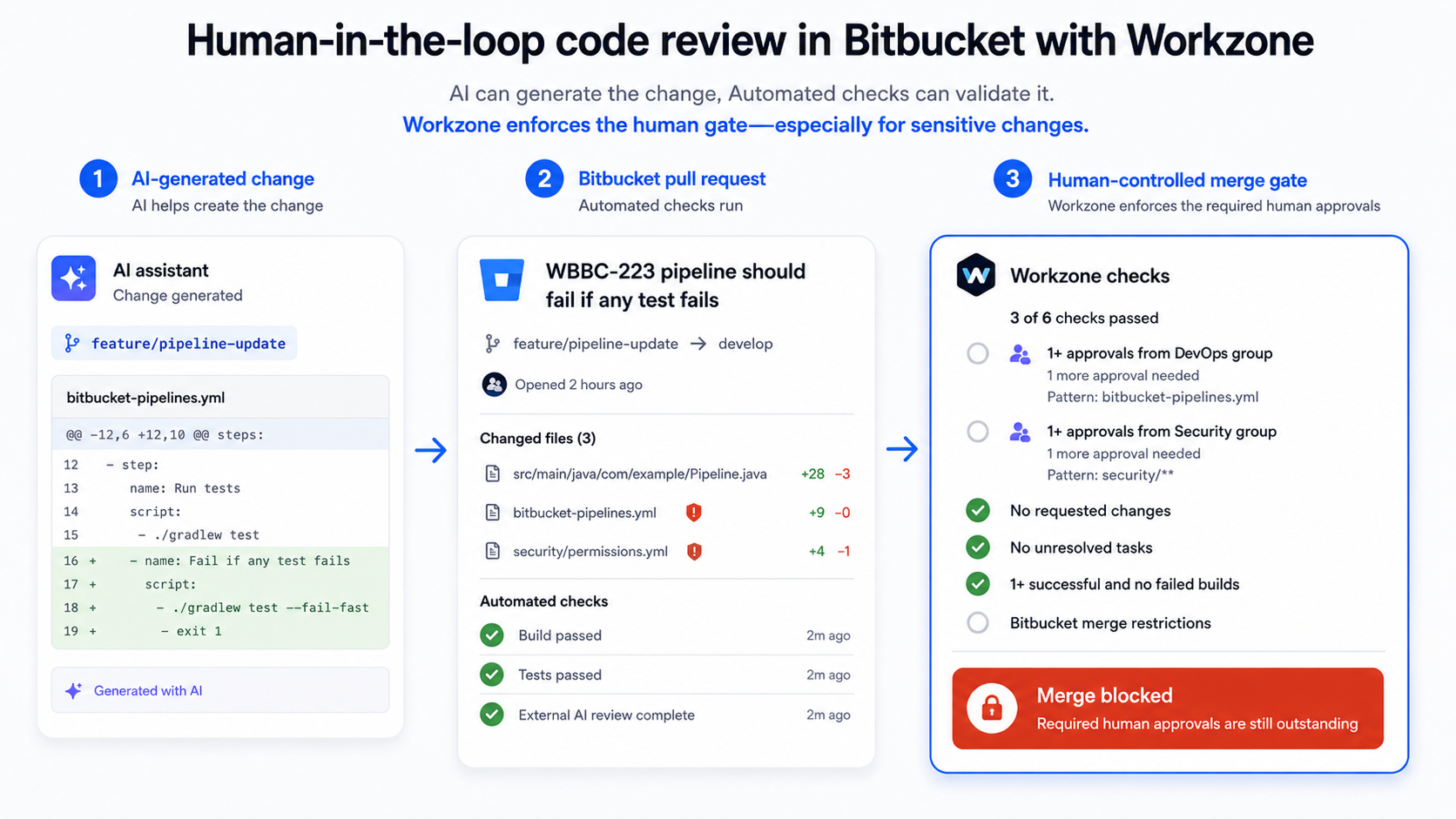
When it is enabled, Workzone does not add the configured reviewers or reviewer groups until a successful build is detected for the pull-request source branch.
A simple workflow can therefore look like this:
- The author creates or updates the pull request.
- The CI system runs the configured preliminary build/test job.
- If the build fails, the author fixes the problem without unnecessarily pulling the review group into that iteration.
- When a successful build is detected, Workzone adds the relevant reviewers.
- The human review begins with the pull request already past the automated baseline.
- Workzone can separately require reviewer approvals, successful builds, resolved tasks or other configured merge conditions before merge.
This is especially useful when the same people already receive many pull-request notifications and failed early builds are common enough to create review churn.

What Counts as “The Build Passed”?
This distinction matters.
The Workzone setting is based on a successful build result. It should not be interpreted as a requirement to complete every possible test, environment validation or release-stage check before any human review begins.
A team might use a fast preliminary CI gate that covers things such as:
- compilation;
- unit tests;
- linting or formatting;
- basic static analysis;
- another fast check that establishes the pull request is ready for human attention.
Slower integration, security, performance or environment tests can still run later or in parallel depending on the team’s workflow.
The useful question is:
“Which automated check is fast and reliable enough that there is little value in asking a reviewer to start before it passes?”
When Waiting for the Build Saves Time
This pattern is a good fit when:
- the preliminary build usually finishes quickly;
- failed builds occur often enough to cause real reviewer churn;
- the pull request does not need early human design feedback;
- reviewers are a constrained resource and notification noise is already a problem;
- the build result gives a meaningful signal that the change is ready for detailed review.
In that situation, delaying reviewer assignment can reduce unnecessary interruptions without weakening the actual review policy.
When You Should Review in Parallel Instead
The title is deliberately provocative, but the rule should not be applied blindly.
Starting review before CI finishes can make sense when:
- the build takes a long time;
- reviewers can provide useful architectural or design feedback independently of the build result;
- the pull request is large enough that waiting for CI simply creates idle time;
- CI failures are rare, so delayed reviewer assignment would save little;
- the review is intentionally exploratory or collaborative rather than a final approval step.
For those teams, the fastest overall cycle may be to run CI and human review at the same time, while still blocking merge until all required checks pass.
This is why the Workzone setting is optional and can be applied to the reviewer rules and branch workflows where it actually helps.
A Successful Build Does Not Replace Code Review
A passing pipeline tells you that the checks you automated have succeeded.
It does not necessarily tell you that:
- the implementation is the right design;
- the code is maintainable;
- the change correctly solves the user or business problem;
- the security model makes sense;
- important edge cases were considered;
- the right people have approved a sensitive change.
That remains the job of human review and the broader pull-request policy.
Workzone can combine conditional reviewer assignment with file/path-based reviewer rules, approval quotas, mandatory reviewers, independent-review controls and merge conditions. For the current configuration options, see the reviewer and approval documentation.
Bottom Line
So, should you bother reviewing a pull request before the build passes?
Sometimes yes. Sometimes no.
If a fast preliminary CI check frequently catches problems that force another commit, waiting for that check before notifying reviewers can save real human time.
If CI is slow or reviewers can usefully work in parallel, making everyone wait may only move the bottleneck somewhere else.
The best workflow is the one that puts automated checks and human attention in the order that produces the shortest safe path to merge.
Workzone’s Only after successful build reviewer condition gives Bitbucket Cloud teams the option to make that choice explicitly rather than automatically notifying every reviewer as soon as a pull request exists.
Want to Configure Reviewers After a Successful Build?
See the Workzone reviewer and approval configuration and branch configuration documentation.
For a broader review of your code-review process, see How to Optimize a Bitbucket Code Review Workflow.
By Sean Manwarring, Head of Marketing at Izymes
Published 22 February 2024 · Updated 13 October 2026