
Think Outside the Blocks: How Playing with Lego Can Help Develop Your Career Skills
Think Outside the Blocks: How Playing with LEGO Can Help Develop Your Career Skills
It’s time to take playtime seriously. You’ve likely heard the common advice to “think outside the box,” but perhaps we should look deeper at what that really means.
LEGO has long been a cornerstone of childhood creativity, but building with bricks isn’t just for kids. LEGO activities at work can give people a hands-on way to practise creativity, communication, problem-solving and teamwork—skills that matter in almost any career.
That doesn’t mean an afternoon of building automatically makes someone more innovative or productive. The benefit comes from what people are asked to build, how they explain their ideas, and what the team learns together.
What Can Playing with LEGO Teach You at Work?
For starters, you don’t need to be an experienced LEGO builder. Sometimes the most useful part of an activity is explaining why you built something the way you did—not creating the most impressive model.
Problem-solving. A missing brick or an unexpected limitation encourages you to reconsider your original plan and try another approach.
Creativity. Combining colours, shapes and pieces makes abstract ideas tangible. A model can help you explain a possibility that’s difficult to put into words.
Communication. People building the same object may see entirely different things in it. Explaining those differences—and listening to other interpretations—is useful practice.
Collaboration. Working towards a shared model means negotiating ideas, breaking a larger challenge into smaller tasks and making room for other people’s contributions.
These aren’t guaranteed career outcomes. They’re skills a thoughtfully designed building activity gives you an opportunity to practise.
How to Encourage Creative Thinking with LEGO
Finding creative solutions to workplace problems can require unconventional brainstorming. LEGO gives people something physical to experiment with, rather than asking everyone to come up with ideas while staring at a blank page.
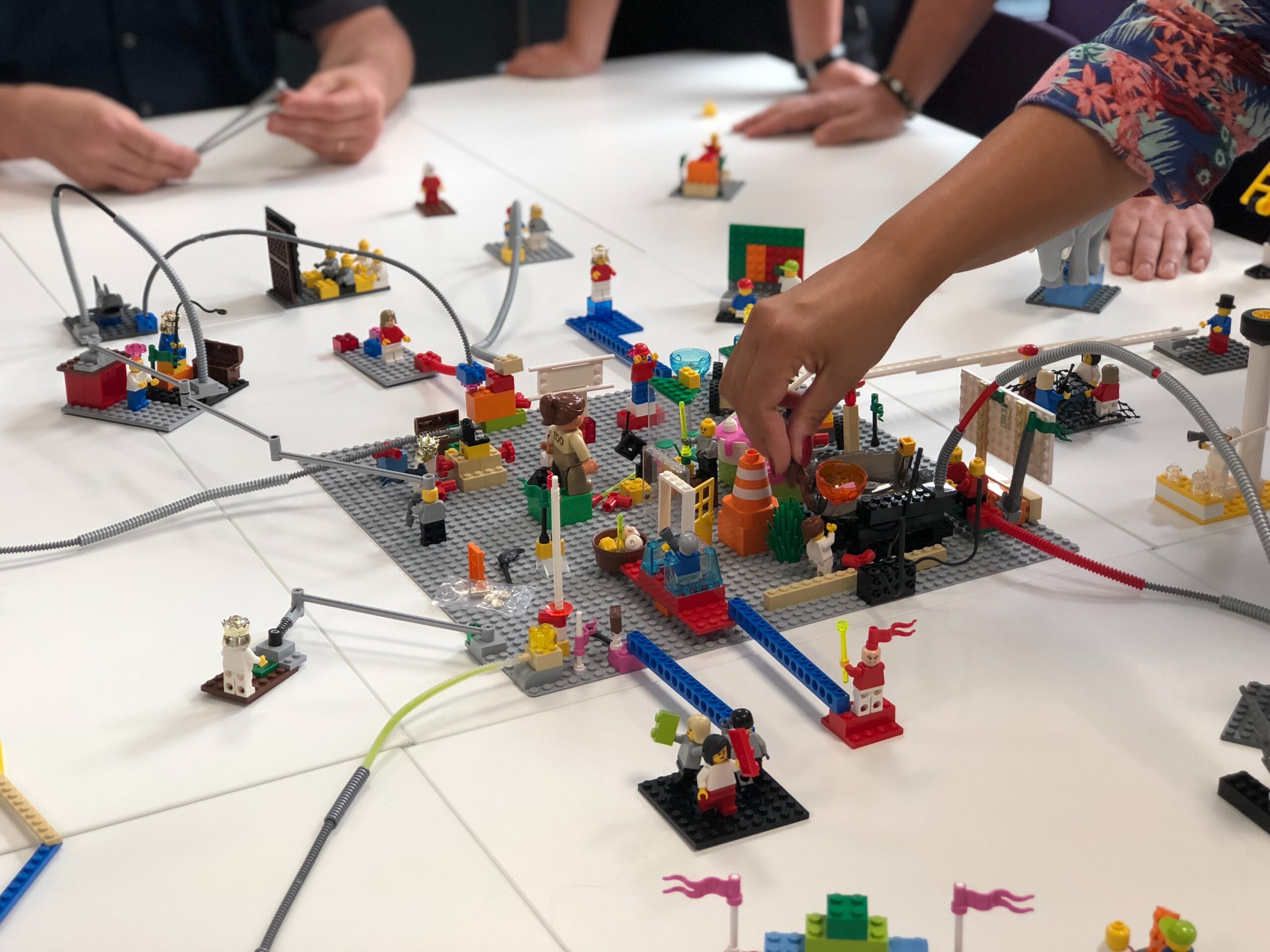
Imagine asking your team to build a model of your ideal customer experience, or show the biggest obstacle preventing a project from moving forward. One person might build a bridge, another a maze, and a third a tower with an unstable foundation. The models create starting points for conversations you might not have had in an ordinary meeting.
You don’t need fancy design skills—or the “right” pieces. In fact, working around a missing piece may be the most useful part of the exercise.

How LEGO Activities Can Foster Collaboration and Teamwork
When a group of colleagues gets together to build something, everyone brings different perspectives to the table. One person may focus on planning, another on the details and another on how the finished model tells a story.
Building together creates opportunities to practise listening, explaining decisions and finding common ground. It can also help people from different roles or departments share perspectives that might not emerge during a typical meeting.
But the activity matters less than how the conversation is facilitated. If the loudest person makes all the decisions—or colleagues feel forced to participate—the exercise can miss its purpose. Give everyone time to contribute and make the experience welcoming rather than competitive.
What Is LEGO SERIOUS PLAY?
There is also a more structured approach called LEGO SERIOUS PLAY. Unlike simply gathering around a pile of bricks, this method uses guided building challenges, models and storytelling to support reflection and dialogue. LEGO made the method available as a community-based, open-source approach in 2010.
The distinction is worth making: a casual LEGO team activity is not automatically a LEGO SERIOUS PLAY workshop. The structured method has its own process and facilitation principles.
There’s some research behind the approach, although the evidence shouldn’t be overstated. A 2022 study comparing LEGO SERIOUS PLAY with traditional meetings involving 39 practitioners in six teams found stronger creative output in the LEGO SERIOUS PLAY sessions. That’s encouraging, but it’s a relatively small study—not proof that every LEGO activity increases productivity or improves careers.
Try a Simple 20-Minute LEGO Team-Building Activity
Want to give it a go without organising a full workshop? Here’s one practical exercise inspired by the same general principles of building, sharing and reflection:
- Set a challenge (2 minutes). Ask everyone to build a model showing one obstacle that slows our team down.
- Build individually (5 minutes). Let each person create something without having to explain it immediately.
- Share the story (8 minutes). Give everyone a chance to explain what their model represents. Ask questions rather than judging the build.
- Find common themes (3 minutes). Discuss recurring obstacles or surprising differences between the models.
- Choose one action (2 minutes). Agree on a small change worth testing at work.
The outcome isn’t the LEGO creation itself. It’s the shared understanding—and, ideally, one useful action you can take away from it.
Tips for Making the Most of Your LEGO Experience
The original advice still stands: keep the atmosphere lighthearted, encourage creative thinking and take time to reflect afterwards. A few details make a big difference:
- Make participation welcoming, not compulsory. People have different comfort levels, access needs and ways of expressing ideas.
- Give everyone a voice. A good team exercise isn’t a competition for the best-looking model.
- Use constraints deliberately. Fewer pieces or an unexpected missing component can encourage alternative solutions.
- Connect the activity to a real question. “Build something cool” may be fun, but a meaningful challenge makes the conversation more useful.
- Reflect and follow through. Ask what the team learned and what, if anything, should change afterwards.

Can Playing with LEGO Really Improve Workplace Skills?
It can provide a useful setting in which to practise them, but playing with LEGO alone isn’t a guaranteed shortcut to better performance. What matters is the purpose of the activity, the quality of the discussion, and whether the lessons carry over into day-to-day work.
A systematic review of 35 studies on play at work found that the outcomes are context-dependent: meaningful, voluntary workplace play can support collaboration and wellbeing, while poorly designed or imposed activities can have the opposite effect.
So keep the goal realistic. You aren’t trying to turn a box of bricks into a miracle productivity tool. You’re making a little room for curiosity, experimentation and a different kind of conversation.
Conclusion: Don’t Be Afraid to Get a Bit Playful
At its core, building with LEGO is about exploration and creativity—two qualities worth bringing into any workplace. Whether you’re practising problem-solving on your own or creating something with colleagues, the experience can offer a different way to think about familiar challenges.
So don’t be afraid to get a bit playful at work. You might be surprised by the ideas that emerge.
And yes, I could talk about LEGO all day!
A note from 2023: We originally published this article ahead of Atlassian Team ’23, when we invited visitors to the Izymes booth for LEGO activities and prizes. That event has passed, but the enthusiasm behind the invitation hasn’t changed.
Explore More from Izymes
We care about helping teams work better together, whether that’s through creative conversations or less repetitive work in their Atlassian tools. If you’re curious about what we’re building, explore the Izymes apps on the Atlassian Marketplace.
By Sean Manwarring, Head of Marketing at Izymes
Published 29 March 2023 · Updated 19 October 2026