Izymes builds easy-to-use apps for Atlassian applications that boost your productivity, free you from performing repetitive tasks inside Confluence, Jira and Bitbucket and enable you to use your time for what you do best – YOUR job.
Interested in a 1-on-1 demonstration of Izymes’s products?
Here we will walk you through;
• All features and benefits of the product you are interested in trying.
• How to set up the account and configure the settings.
• Other tips, tricks and best practices.
It will also give us time to answer any questions you may have, or perhaps you just want to have a chat, we love a good chat.
You can schedule a time on the Calendly link below. Talk soon!
How to Protect Critical Code in Bitbucket in the Age of AI
How to Protect Critical Code in Bitbucket in the Age of AI
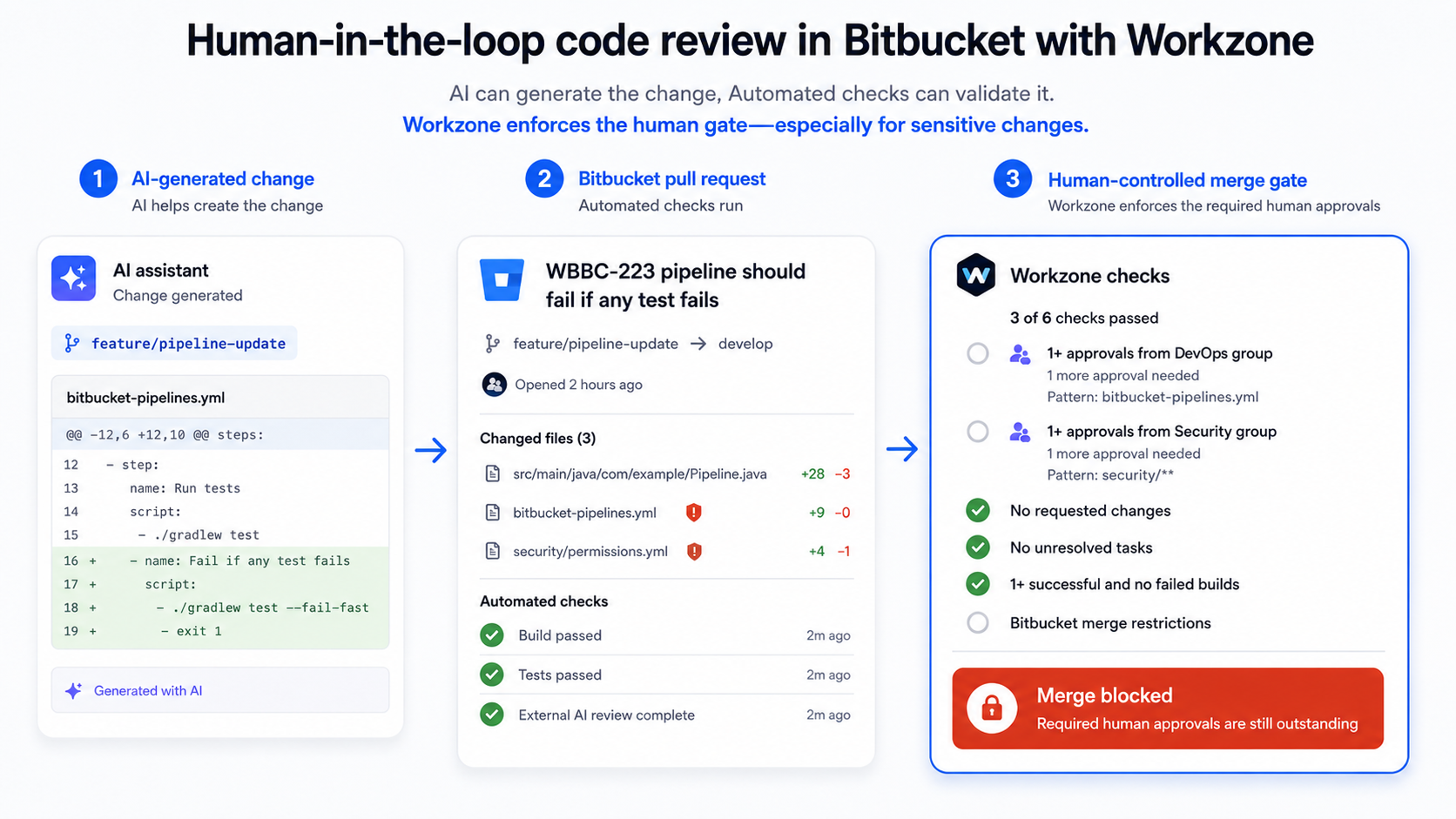
AI-assisted development can dramatically increase the amount of code a team produces. To protect critical code in Bitbucket without turning every pull request into a bottleneck, identify the files and modules with the greatest blast radius, automate the checks machines can perform reliably, and make the right human approval a blocking requirement before high-risk changes can be merged.
Critical code is code or configuration where an incorrect, unauthorised or insufficiently reviewed change could create disproportionate security, operational, financial, regulatory or customer impact. Examples might include authentication logic, deployment pipelines, infrastructure-as-code, database migrations, billing rules and regulated workflows.
This is a form of risk-based code review: review depth follows the potential consequence of getting a change wrong rather than treating every pull request as equally risky.
Note: This article focuses primarily on Bitbucket Cloud. Workzone is also available for Bitbucket Data Center, but Bitbucket’s native review and merge capabilities differ between the platforms.
Key Takeaways
AI-assisted development increases code throughput, so review effort needs to be allocated according to risk rather than spread equally across every change.
Bitbucket Cloud CODEOWNERS can automatically assign reviewers based on changed paths, while Bitbucket merge checks can enforce general approval and build requirements.
Workzone reviewer rules can connect file/module patterns to particular reviewers or groups and explicit approval quotas.
Independent review can be strengthened by excluding approvals from people who contributed commits to the pull request when calculating the Workzone quota.
Human review should complement tests, builds, security scanning and AI review—not replace checks that machines can perform more consistently.
AI Has Changed the Code Review Bottleneck
The simple story about AI-assisted software development is that developers can now write code faster.
That is true, but it misses a more important change: producing code is becoming easier than understanding and verifying it.
An AI agent can generate a feature, refactor a module, update tests and prepare a pull request in a fraction of the time the same work may previously have taken. The resulting code can look polished, follow familiar patterns and even pass its tests.
That creates a different kind of risk.
Obviously bad code is often relatively easy to detect. More difficult is plausible code: code that looks correct, compiles successfully and passes expected tests while subtly changing behaviour, introducing an edge case or making an assumption the team never intended.
For Bitbucket teams, much of that verification pressure eventually arrives at the pull request.
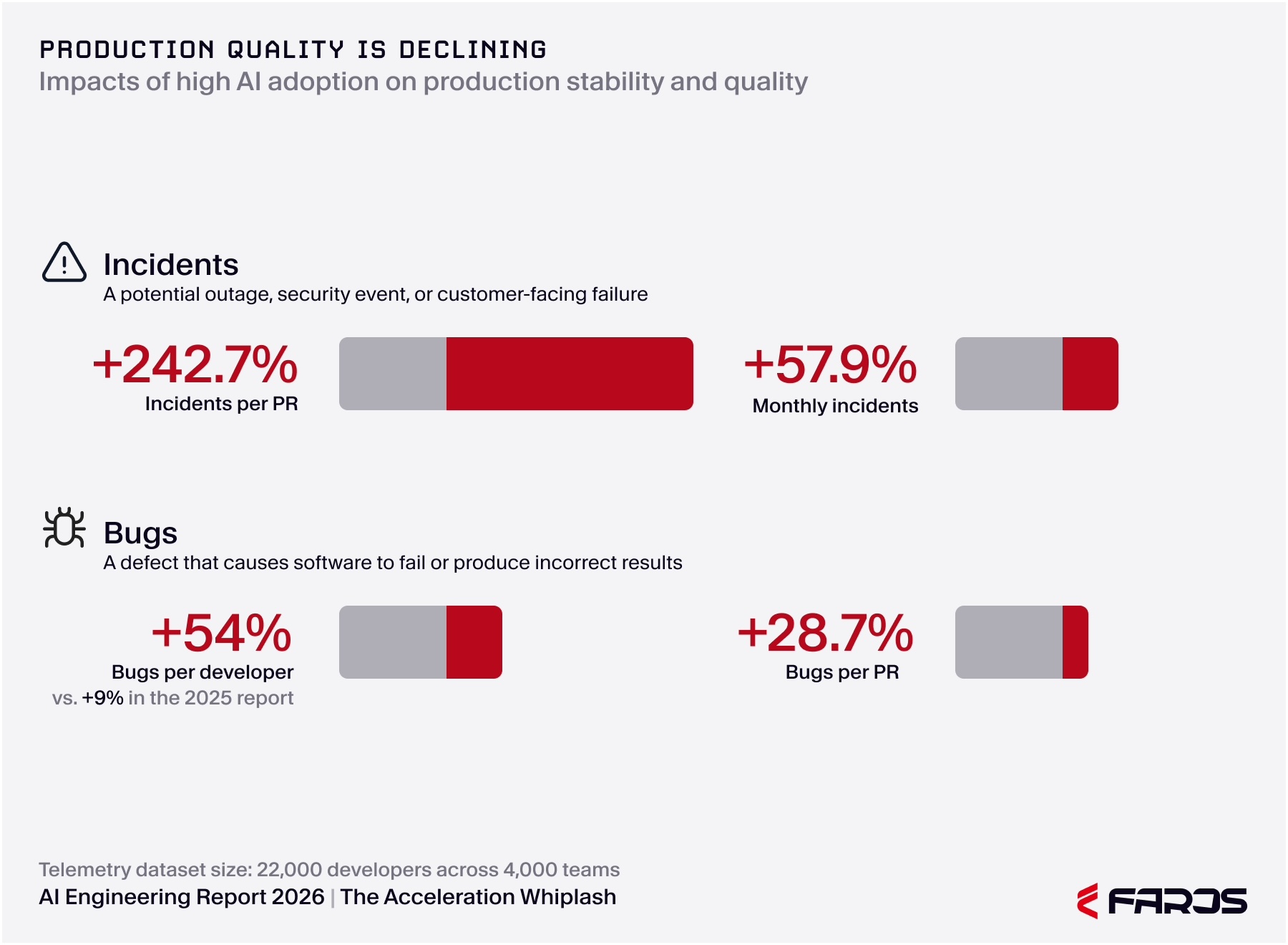
Faros AI’s 2026Acceleration Whiplashreport, based on two years of telemetry from 22,000 developers across more than 4,000 teams, reports larger pull requests, longer median review times, more incidents per pull request and substantially greater code churn alongside higher AI adoption.
DORA’s 2025 State of AI-assisted Software Development provides a useful broader perspective. DORA describes AI primarily as an amplifier of the engineering system around it: it can magnify the strengths of a strong delivery system as well as weaknesses in an unstable one.
These studies use different methodologies, so the point is not that every team using AI will experience the same result.
The practical lesson is simpler:
Faster code generation increases the importance of having a review system that knows where human attention matters most.
AI Review Is Useful, but It Is Not Ownership
AI can also help with the review problem.
AI code reviewers can flag suspicious logic, missing tests, security concerns, inconsistent patterns and other potential problems before a human reviewer spends time on a pull request.
That makes AI an increasingly useful sensor in the review process.
But a sensor is not the same thing as an accountable owner.
An AI reviewer can flag a potential problem or conclude that a change looks reasonable. It cannot take organisational responsibility for a production incident or decide on behalf of your organisation whether a particular customer, regulatory, architectural or operational risk should be accepted.
AI can scale checking. Human reviewers still own judgement.
The practical question for a Bitbucket team is therefore not whether humans should inspect every AI-assisted line of code. It is:
Where must human judgement remain a required part of the merge decision?
How to Protect Critical Code in Bitbucket Based on Blast Radius
Not every file in a repository carries the same risk.
Changing a documentation page is not equivalent to changing authentication logic. Updating UI copy is not equivalent to modifying a production deployment pipeline. A low-risk refactor is not necessarily comparable to a change affecting customer data, infrastructure, billing or a regulated workflow.
A practical way to protect critical code in Bitbucket is to make review depth follow the blast radius of getting the change wrong.
Changed area
Typical risk
Illustrative review policy
docs/**
Low
Automated checks and lightweight review
src/ui/**
Moderate
Review from the team responsible for the UI
src/auth/**
High
Required approval from responsible security/backend reviewers
infrastructure/**
High
Platform or release-team approval plus successful build
db/migrations/**
High
Required approval from the appropriate backend/data owner
These are examples, not universal rules. Every organisation has its own architecture, ownership model and risk profile.
The useful question is:
Which parts of our repository should never reach a protected branch without approval from the people accountable for them?
Depending on the organisation, that might include:
CI/CD pipeline configuration;
infrastructure-as-code;
deployment scripts;
authentication and authorisation logic;
security and permission configuration;
database migration scripts;
billing, payment or licensing logic;
regulated workflow code;
critical customer-facing configuration.
An AI agent can still propose changes to these files. A developer can still commit them.
The enforceable control point is whether those changes can be merged without satisfying the appropriate review requirements.
Workzone Turns Code Ownership Into an Enforceable Review Rule
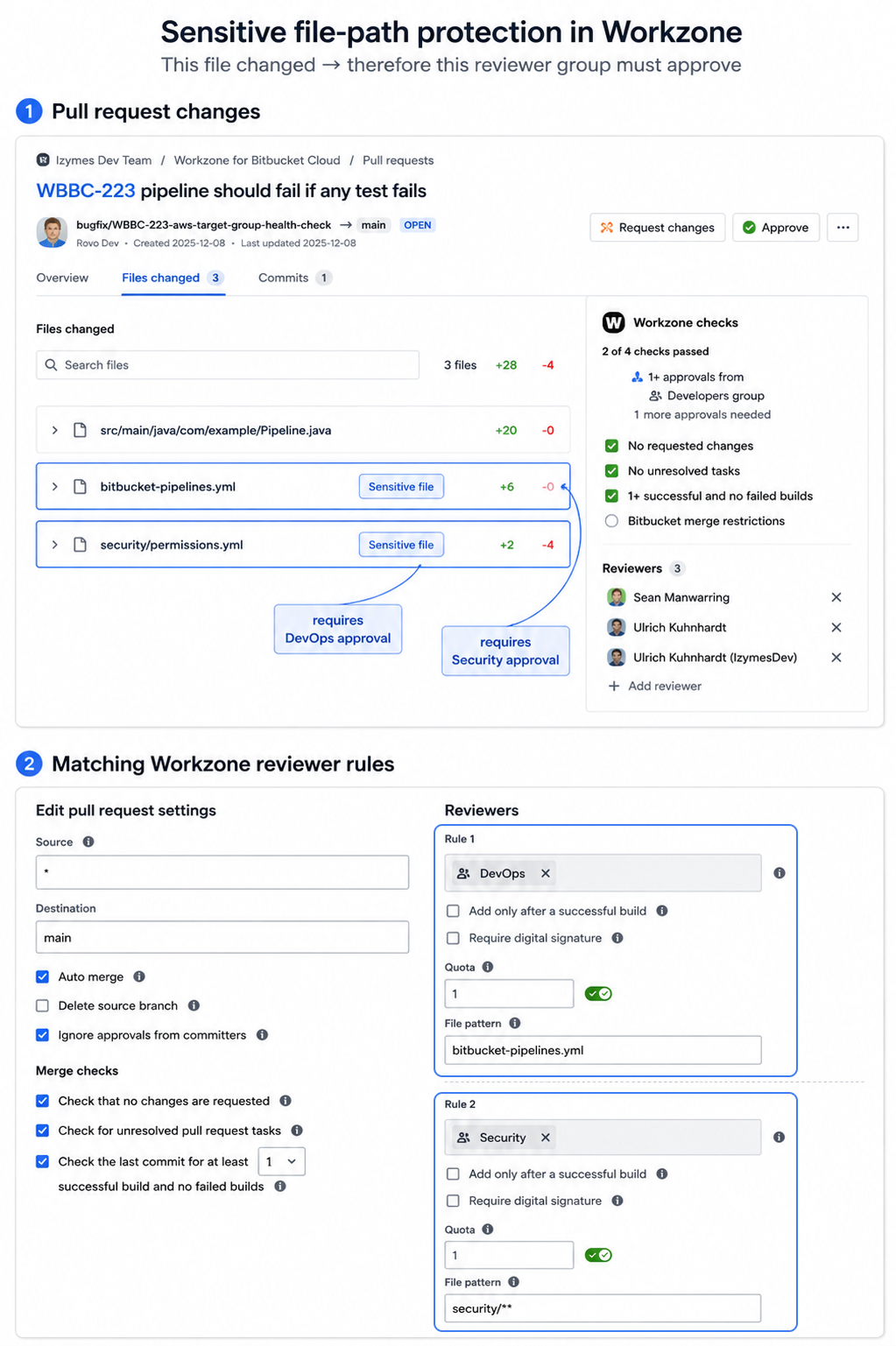
Workzone for Bitbucket allows pull request reviewer rules to reflect the part of the codebase being changed.
Its reviewer and approval configuration can use branch patterns, file or module patterns, individual reviewers, reviewer groups and approval quotas.
For example, a team could configure changes under src/ui/** to require approval from UI reviewers, while changes to authentication code require approval from the appropriate backend or security group.
For particularly sensitive paths, the reviewer rule and approval quota become part of the Workzone merge requirements.
This turns:
Someone from this team should probably review changes here.
into:
This pull request cannot satisfy the configured Workzone merge requirements until the required review condition has been met.
Example of a Workzone reviewer rule using a file pattern and approval quota to enforce review ownership for a specific area of the codebase.
The workflow therefore does not depend on somebody manually noticing that a sensitive file happens to be buried inside a large AI-assisted diff.
Independent Review Matters When Authorship Gets Messy
AI-assisted development can also make authorship less straightforward.
A developer may generate the original change with an AI agent. Another engineer may modify it. Someone might approve the pull request and later contribute another commit.
For many low-risk workflows, that may not matter.
For processes that require independent review, however, there is a more important question:
Should the approval of someone who contributed to the change still satisfy the independent approval requirement?
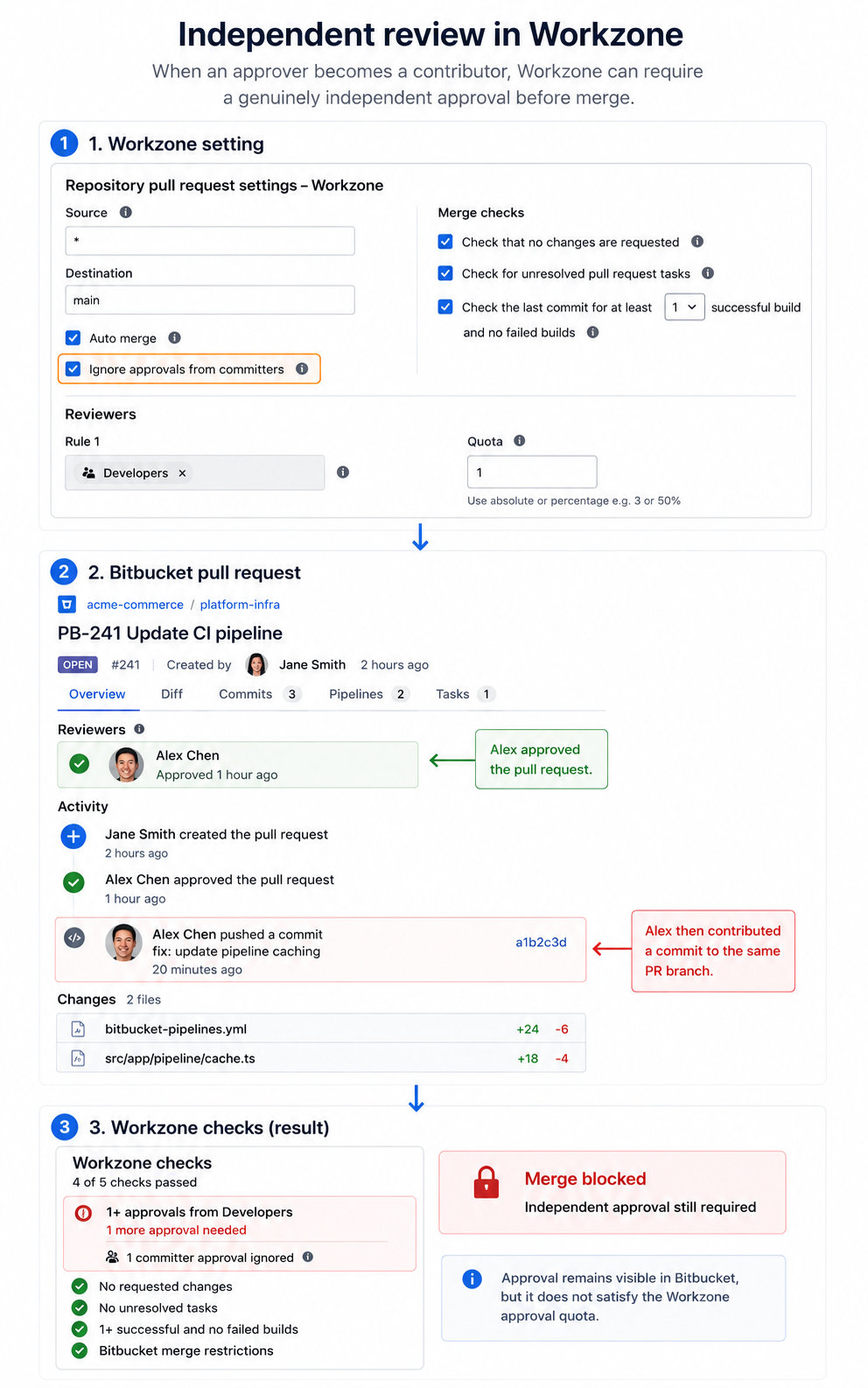
The approval remains visible in Bitbucket, but if the reviewer has contributed commits to the pull request, Workzone excludes that approval from the configured quota calculation.
Workzone can exclude approvals from users who contributed commits when calculating the required approval quota.
This allows teams to distinguish between an approval and an independent approval.
Use Automation to Protect Human Attention
Keeping humans in the loop does not mean replacing automation with manual process.
The opposite is usually more effective.
Linters, automated tests, builds, security scanners, AI review tools and other deterministic checks should handle work that machines can perform consistently.
Human attention can then be concentrated on questions that require context and accountability:
Is this the right change?
Does it introduce an unacceptable risk?
Does it fit the architecture?
Does it affect contractual, security or compliance requirements?
Is the organisation comfortable putting this change into production?
Workzone branch configurations can combine reviewer requirements with conditions such as successful builds, unresolved tasks, requested changes and approval requirements.
There is also a useful reviewer-level optimisation: Workzone can be configured to add reviewers only after a successful build. For teams with expensive human review capacity, this can prevent reviewers being pulled into a change that has not yet passed a basic machine-enforced gate.
That is a good example of what human-in-the-loop engineering should look like: automation filters routine failure modes so scarce human attention is spent where judgement adds value.
Some Changes Need a Signature, Not Just an Approval
For many teams, a normal pull request approval is enough.
For some regulated or high-risk workflows, the organisation may need stronger evidence around who approved a change and in what capacity.
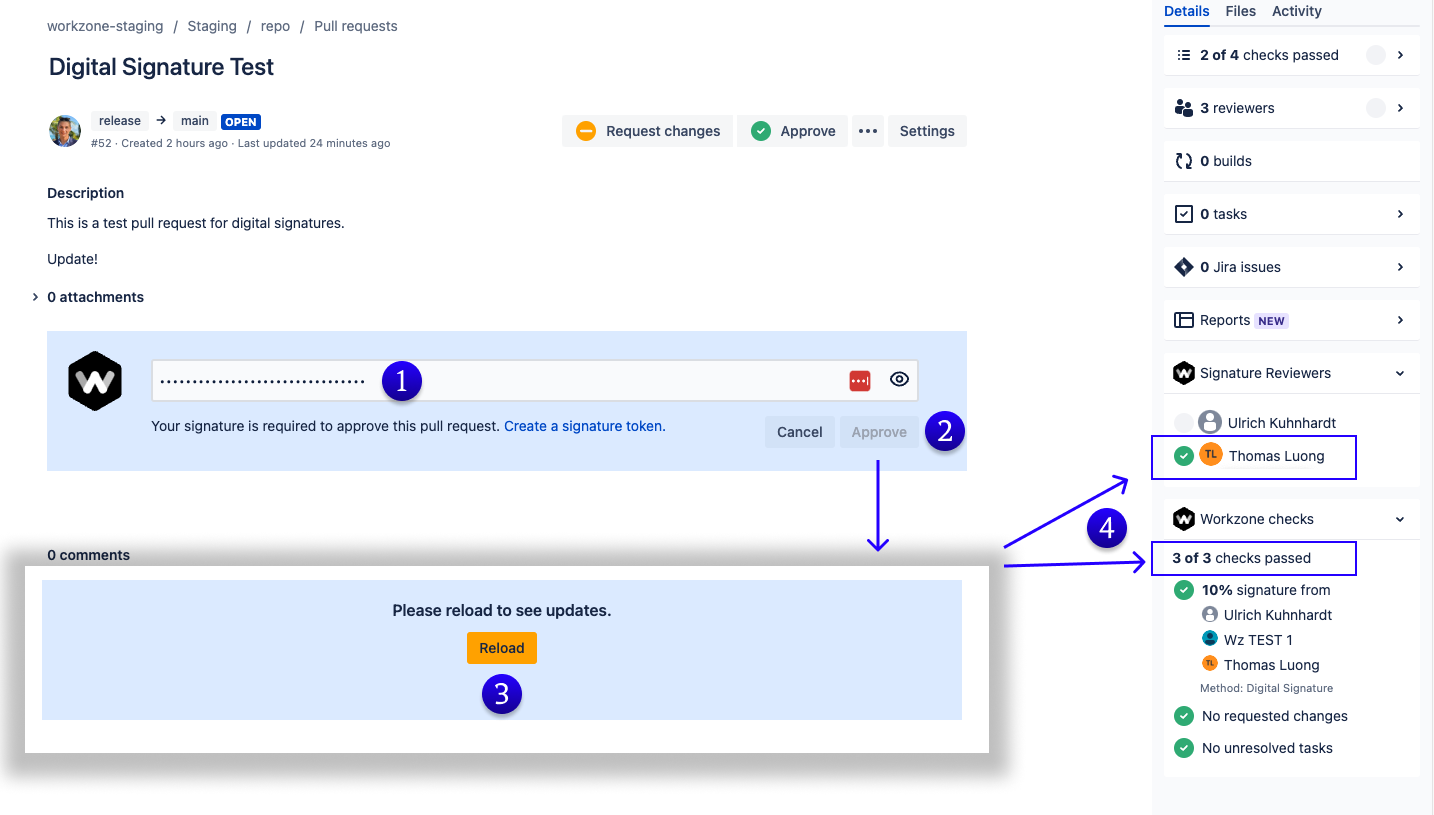
Workzone digital signatures can make pull request approval a more explicit and traceable action for workflows that require it.
Not every team needs this. A digital signature requirement should only be introduced when the process genuinely requires stronger traceability or explicit sign-off.
But where it is required, the distinction matters: the evidence around the approval becomes part of the workflow rather than something the team has to reconstruct later.
How Izymes Uses Workzone in Its Own Development Process
This is not only a workflow we recommend to customers.
Izymes uses Workzone within our own software development lifecycle.
Our published Security Practices describe a process in which development work is tracked, changes are submitted through Bitbucket Cloud pull requests, and Workzone adds reviewers and groups based on the changes in the pull request.
In that workflow, the configured reviewers must satisfy the applicable approval quota and an automated Snyk security check must pass before Workzone merges the pull request.
This is a useful example of the principle behind the article:
Machine-enforced checks and accountable human review should reinforce each other.
The goal is not to make humans perform every check manually. It is to design the workflow so that automation handles what can be automated reliably while the required human decision remains load-bearing where it matters.
Bitbucket CODEOWNERS vs Workzone
Bitbucket Cloud already provides useful native controls, so it is important to distinguish what Bitbucket can do from what Workzone adds.
Bitbucket Cloud CODEOWNERS uses a .bitbucket/CODEOWNERS file to map code paths to individuals, workspace groups or teams and automatically add suitable reviewers based on the files changed in a pull request.
Separately, Bitbucket’s native merge checks can require conditions such as a minimum number of approvals, approvals from default reviewers, successful builds, no requested changes and no unresolved tasks. On Premium, unresolved merge checks can be configured to block merging.
For many teams, that may already be enough.
The difference becomes important when the approval rule needs to follow the particular file/module ownership rule that matched the change.
Requirement
Bitbucket Cloud native
Workzone
Automatically add reviewers based on changed files/paths
Yes, with CODEOWNERS
Yes
Use individuals, groups or teams as path owners/reviewers
Yes
Yes
Require a general minimum number of approvals before merge
Yes; blocking enforcement requires the appropriate Premium configuration
Yes
Associate an explicit approval quota with the particular file/module reviewer rule that matched the change
Not through CODEOWNERS itself
Yes
Exclude approvals from reviewers who contributed commits when calculating the Workzone quota
No equivalent CODEOWNERS rule
Yes
Require Workzone digital signatures as part of the approval policy
No native equivalent
Yes
Bitbucket Cloud also supports custom Forge merge checks, which gives organisations another route for implementing workflow-specific controls.
So the question is not:
Can Bitbucket enforce approvals?
It can.
The better question is:
Does our approval policy need to follow the particular files, modules and owners involved in this change?
That is where Workzone’s reviewer rules and approval quotas become particularly relevant.
Not every Bitbucket team needs additional workflow tooling.
If your team has a straightforward review process and Bitbucket CODEOWNERS plus native merge checks already provide the controls you require, keeping the workflow simple may be the right choice.
Workzone becomes more relevant when your requirements include combinations such as:
file or module-specific reviewer rules tied to explicit approval quotas;
mandatory reviewer users or groups;
different review policies across branches or areas of the repository;
independent-review requirements where contributor approvals should not satisfy the quota;
digitally signed approvals;
more detailed control over reviewer assignment and merge policy.
The objective should never be to add process for the sake of process.
It should be to make the minimum level of governance your organisation actually needs consistently enforceable.
The Human in the Loop Is a Design Choice
AI will continue to become more deeply involved in software development.
That does not mean every AI-assisted pull request should require exhaustive manual review. Nor does it mean automated systems should write, review and ship high-risk changes without accountable human oversight.
Teams need to decide deliberately where humans remain load-bearing.
Let automated systems handle checks they can perform reliably. Identify the parts of the codebase where mistakes carry the greatest consequences. Then make sure the people accountable for those areas remain a required part of the merge decision.
If your goal is to protect critical code in Bitbucket, the key question is not whether humans or AI should do the reviewing. It is which checks should be automated, which decisions require accountable human approval, and how those requirements are enforced consistently.
The teams that benefit most from AI-assisted development may not be the teams that simply generate the most code.
They will be the teams that can still confidently stand behind what they merge.
Want to Enforce More Granular Reviewer and Approval Rules in Bitbucket?
Explore Workzone’s reviewer and approval configuration to see how file/module rules, reviewer groups, approval quotas and independent-review controls can be incorporated into a Bitbucket pull request workflow.
If Bitbucket’s native CODEOWNERS and merge checks already meet your requirements, keep your workflow simple. If you need more granular control over who must review specific areas of the codebase, try Workzone for Bitbucket on the Atlassian Marketplace.
By Sean Manwarring, Head of Marketing at Izymes Published 6 August 2026 · Updated 12 October 2026




Pingback: Secure Your Bitbucket Development Process | Izymes
October 13, 2026