


Turning Bitbucket Apps into Service Bundles: Our Approach for Atlassian Solution Partners
Bitbucket Service Bundles for Atlassian Solution Partners: Our Approach
Bitbucket service bundles for Atlassian Solution Partners turn individual Marketplace apps into repeatable, outcome-led consulting offers. Instead of leading with “here is an app”, the partner leads with a customer problem—such as slow pull-request flow, weak release traceability or inconsistent governance—and uses Izymes apps as accelerators inside the assessment, design, implementation and enablement work.
A service bundle is a packaged consulting offer with three parts: a clearly defined customer outcome, a repeatable partner delivery method, and the tools or app configurations that help make the new process stick.
That model fits naturally with the role Atlassian describes for Solution Partners: providing product knowledge, configuration expertise, customised solutions and implementation services—not simply reselling software.
This article explains why we are packaging our Bitbucket apps this way, how the bundles are structured, and how an Atlassian Solution Partner can use them without giving up ownership of the customer relationship or the consulting engagement.
Key Takeaways
- Lead with the customer outcome—release readiness, PR flow or governance—not the app feature list.
- A useful service bundle combines an outcome, a repeatable partner engagement and apps/configuration as accelerators.
- The partner still owns assessment, process design, implementation, training and ongoing customer advice.
- Izymes apps are intended to make the resulting Bitbucket workflow easier to configure, enforce and repeat—not replace partner services.
- Not every customer needs a bundle; if native Bitbucket or a simple app installation already solves the problem, keep the engagement simple.
The Gap We Kept Seeing in Bitbucket Projects
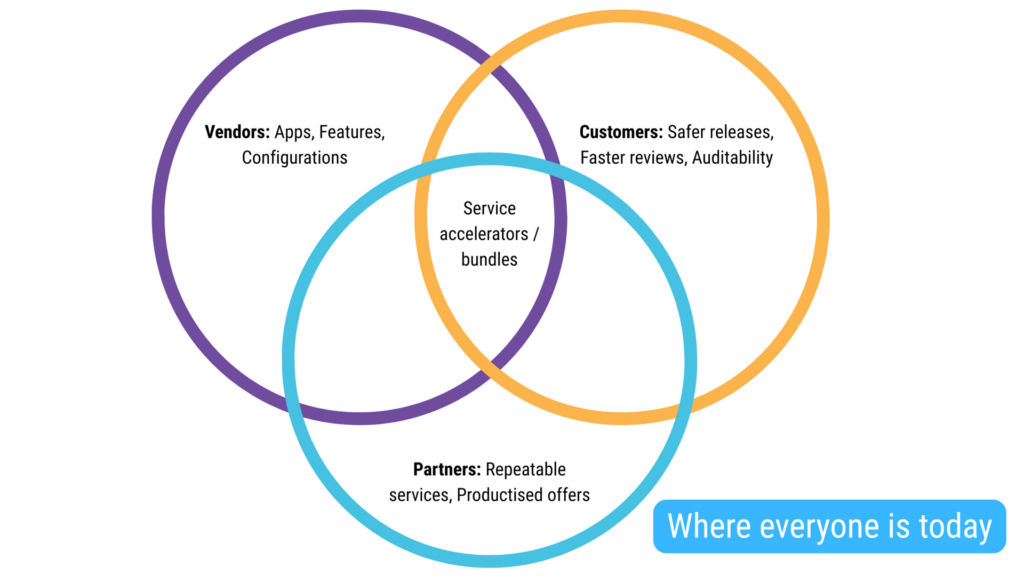
Most Marketplace vendors—including us at Izymes—have spent years talking about apps.
“Here’s a Bitbucket app that enforces pull request rules.”
“Here’s another that helps you find the right pull requests.”
But that is not usually the conversation an Atlassian Solution Partner is having with a customer.
The customer is more likely to say:
- “Our releases keep getting held up at the last minute.”
- “Pull requests sit waiting for the same reviewers.”
- “Our review rules are inconsistent across teams.”
- “We need better evidence that the right people approved sensitive changes.”
- “We cannot easily see or coordinate related pull requests across repositories.”
In our conversations with partners and customers, that translation step kept appearing. Customers wanted outcomes such as safer releases, faster reviews and better auditability. Partners wanted something they could turn into a repeatable service rather than designing a new engagement from scratch every time.
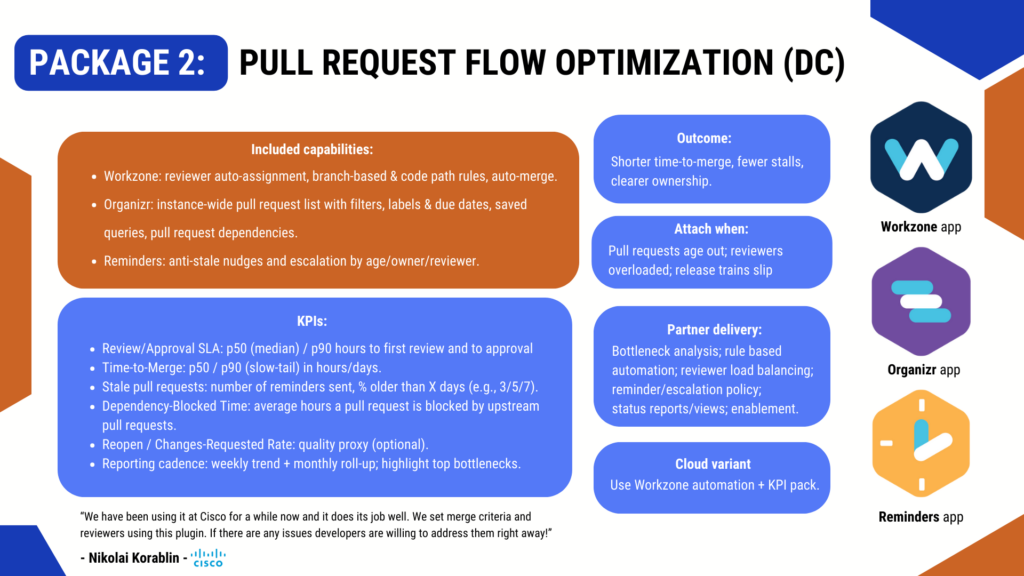
Our Bitbucket apps already addressed specific parts of those problems. Workzone focuses on reviewer, approval and merge governance. Organizr provides instance-wide pull-request organisation and merge dependencies for Bitbucket Data Center. Reminders for Bitbucket helps Data Center teams follow up overdue reviews and approvals.
What was missing was the service story around them:
How does a Solution Partner turn these capabilities into a concrete engagement that can be explained, scoped, delivered and repeated?
That is the gap our service-bundle approach is intended to close.
How Bitbucket Service Bundles for Atlassian Solution Partners Work
Instead of starting with an app, we start with a customer outcome a partner could credibly put on a proposal or service slide.
Three examples are:
| Service bundle | Customer problem | Typical partner work | Possible Izymes accelerators |
|---|---|---|---|
| Release Readiness & Traceability | “We keep getting surprised at release time.” | Assess release flow, map approval and dependency requirements, design target controls, configure and enable the team. | Workzone; Organizr where Bitbucket Data Center cross-repository coordination is part of the problem. |
| Pull Request Flow Optimisation | “Reviews are slow and the same people become bottlenecks.” | Review PR flow, ownership and wait states; redesign reviewer and merge rules; train teams and measure improvement. | Workzone; Reminders for overdue reviews in Bitbucket Data Center environments. |
| PR Governance & Compliance | “We need consistent review controls and better approval evidence.” | Map governance requirements to Bitbucket workflows, implement controls, document exceptions and establish ongoing health checks. | Workzone reviewer rules, approval quotas, merge checks and digital signatures where required. |
The exact app combination should follow the customer’s hosting model and requirements. For example, Workzone is available for Bitbucket Cloud and Data Center, while Organizr and Reminders are currently Bitbucket Data Center apps.
The point is not to force every app into every engagement. The bundle gives the partner a repeatable starting framework, then the actual solution is adapted to the customer.
Each Bundle Has Three Layers
1. Outcome and Story
Start with the problem the customer recognises and the improvement they want.
For a Pull Request Flow Optimisation engagement, that might mean:
- shorter review wait time;
- clearer ownership for sensitive code areas;
- fewer manual reviewer handoffs;
- more consistent merge requirements.
The outcome should be understandable before any app is mentioned.
2. Partner Services
The Solution Partner owns the work that requires customer context and judgement:
- current-state assessment of Bitbucket and pull-request practices;
- identification of bottlenecks and governance gaps;
- design of the target workflow;
- implementation in Bitbucket and, where relevant, Jira or Confluence;
- training and enablement;
- follow-up measurement and health checks.
This is where the partner’s experience matters. Two customers can use the same Bitbucket app and still need very different policies.
3. Apps as Service Accelerators
The apps are there to make the agreed process repeatable and enforceable.
For example, Workzone reviewer rules can map branches and file/module patterns to specific reviewers or groups and approval quotas. Workzone merge checks can enforce conditions such as successful builds, completed tasks and required approvals. For regulated workflows that genuinely require stronger sign-off, digital signatures can be included in the merge policy.
For Bitbucket Data Center, Organizr can surface pull requests across the instance, while labels, due dates and merge dependencies can support release coordination. Reminders can follow up reviewers and stakeholders when pull requests become overdue.
That is what we mean by an accelerator: the app reduces the amount of custom workflow machinery the partner has to build and helps the agreed process continue after the consulting engagement ends.
What a Repeatable Partner Engagement Could Look Like
A bundle does not need to prescribe every workshop or deliverable. It should provide enough structure that the engagement is repeatable while leaving room for the partner to adapt it.
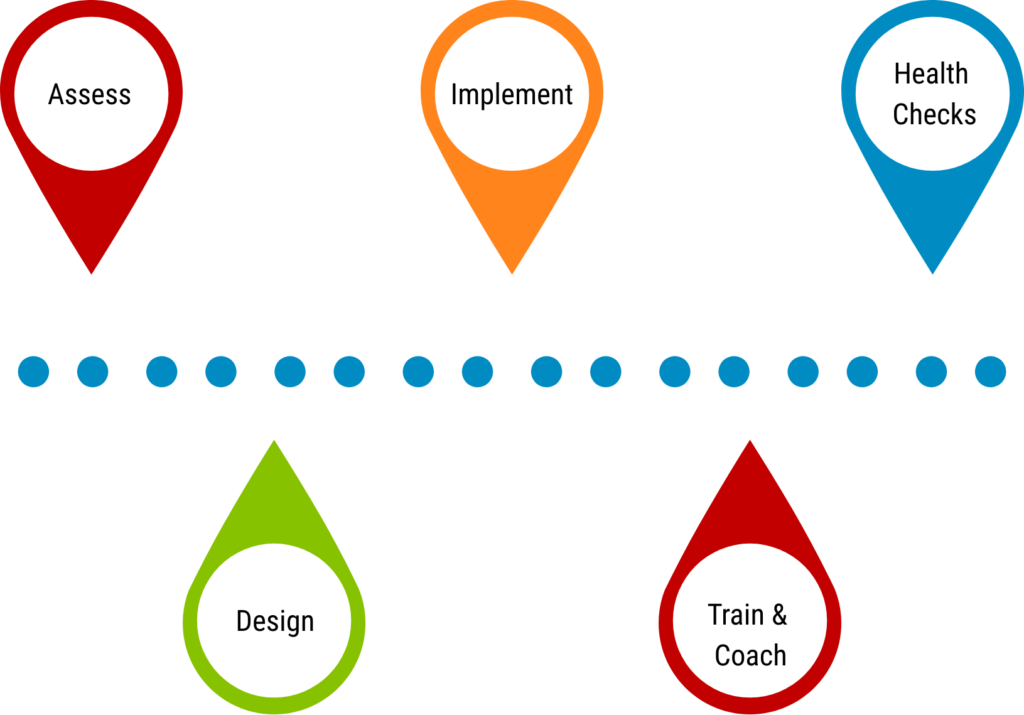
A practical delivery pattern is:
- Assess — review the current Bitbucket workflow, bottlenecks, policies and customer objectives.
- Define — agree on the target outcome and how improvement will be measured.
- Design — decide which controls belong in native Bitbucket and where an app adds value.
- Implement — configure the workflow, reviewer rules, merge controls, metadata or reminders that the target process needs.
- Enable — document the process and train administrators, reviewers and delivery teams.
- Review — check adoption and outcomes after rollout, then refine where needed.
This keeps the app in the right place in the engagement: after the problem and target process have been understood, not before.
Why This Model Makes Sense for Izymes
A Value Story That Is Bigger Than “Another Plugin”
When the conversation starts with release safety, pull-request throughput or governance, it is easier to explain why a particular capability matters.
The customer is not being asked to care about a settings screen. They are being shown how the settings support a process they already want to improve.
More Deliberate Adoption
An app installed as part of a designed workflow is more likely to be configured around a real operating model rather than left on generic defaults.
That gives us better feedback as a vendor and gives the customer a clearer reason for each control that has been introduced.
Alignment With Partner-Led Delivery
We do not want the app to compete with the consulting engagement. We want it to support it.
The partner should be able to say:
“We have a repeatable approach to this problem, and Izymes gives us tooling and configuration patterns that help us deliver it consistently.”
That is also consistent with how Atlassian itself describes Solution Partners: organisations providing consulting, configuration expertise, customised solutions and implementation services.
What Solution Partners Get From the Service-Bundle Approach
1. A Starting Point for Productised Services
You do not have to begin with a blank slide.
The bundle provides:
- a named customer problem and outcome;
- a suggested delivery structure;
- possible measures of success;
- app and configuration patterns that can support the workflow.
The partner can then adapt the language, scope and commercial model to fit its own practice.
2. Less Repeated Discovery Work
Repeatable patterns mean the delivery team does not have to rediscover the same Bitbucket configuration options and common workflow decisions on every engagement.
That does not remove discovery. It makes it easier to focus discovery on what is unique about the customer.
3. More Predictable Delivery
As the same engagement pattern is refined, teams can develop reusable workshop questions, configuration starting points, enablement material and health checks.
That can reduce delivery variation and make it easier to transfer knowledge across the partner’s consulting team.
4. A More Specific Bitbucket Story
Customers do not always arrive with a detailed specification for a Bitbucket app. They often arrive with an operating problem.
A named service such as PR Governance & Compliance or Pull Request Flow Optimisation gives the partner a more concrete way to talk about that problem than simply listing Marketplace products.
When a Service Bundle Is Not Necessary
Not every opportunity needs to become a packaged consulting engagement.
A simpler approach may be better when:
- the customer’s requirement is narrow and already well defined;
- native Bitbucket functionality already solves the problem;
- the customer simply needs an app configured for a straightforward use case;
- the partner already has a mature service offering and only needs a specific accelerator inside it.
The bundle is useful when it removes uncertainty and repeated work. It should not create consulting overhead around a problem that is already simple.
How Izymes Supports Solution Partners
The service-bundle model only works if partners can actually evaluate, demonstrate and deliver the apps behind it.
The Izymes Partners Portal currently provides resources including:
- internal-use licences for testing and customer demonstrations;
- demo setup support;
- training and direct app support;
- sales and marketing materials;
- co-marketing opportunities;
- partner discounts and commercial support.
For the bundles specifically, we also provide a partner-facing Service Offering Deck, suggested implementation patterns, example configurations and direct collaboration on opportunities where the accelerators are a good fit.
The aim is for the relationship to feel less like “installing somebody else’s app” and more like having a Marketplace vendor behind the partner’s delivery team when deeper product knowledge is useful.
If You Are an Atlassian Solution Partner, Here Is What to Do Next
If you are building or refining a Bitbucket / DevOps service portfolio, there are a few ways to explore the model:
- Download the Service Offering Deck — see the current example bundles, positioning and talking points that can be adapted for your own practice.
- Explore the Izymes Partners Portal — review partner resources, demo options, training, commercial support and marketing material.
- Talk to us about a customer opportunity — share the customer problem and we can help identify where our apps fit, and where they do not.
- Book a call to explore a joint offering — walk through the bundles and discuss how they could map to services you already provide.
The goal is not to turn every Bitbucket engagement into an app sale.
It is to give Solution Partners a repeatable way to move from:
“Here are a few Marketplace apps.”
to:
“Here is a service that solves a customer problem, and here are the accelerators that help us deliver it.”
By Sean Manwarring, Head of Marketing at Izymes
Published 2 February 2026 · Updated October 2026


Pingback: Izymes 2025 Wrap: From Apps to Outcome-Led Solutions | Izymes
October 13, 2026